
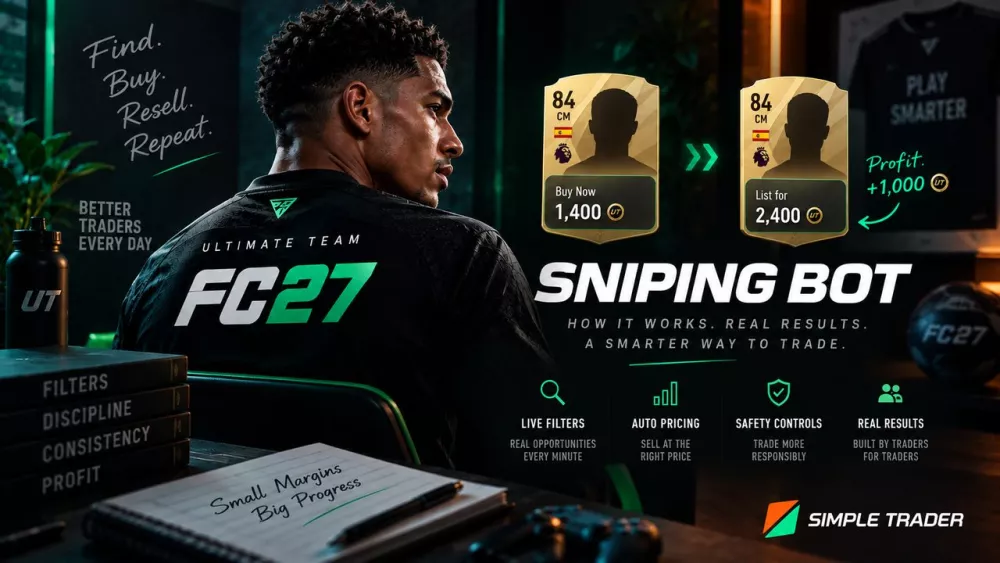
An EA FC 27 sniping bot is a tool that searches the Ultimate Team transfer market on your behalf, using price filters you set, and buys cards listed below their market value so you can resell them at a profit. It does not play the game for you and it does not generate coins out of nothing — it does one job, very fast, over and over: find mispriced listings before a human can.
That is the whole idea. Everything else is detail, and the detail is where most people either make money or waste a subscription. This guide covers all of it.
In short
A sniping bot searches and buys. An autobuyer usually means the same thing, with the selling side automated too.
Search speed alone is not enough. The harder problem is knowing what to search for, and when.
Among our own regular users, monthly returns land in the low millions of coins — not the tens of millions quoted in headline statistics.
Getting started needs Web App access and transfer market access, which are two different things.
Automation breaches EA's rules and there is no risk-free way to do it. There is a large difference between careful use and reckless use.
The transfer market has a search function. You set a player, a position, a rating range, a maximum buy-now price, and the market returns whatever matches. A human does this by typing, pressing search, scanning the results, and repeating.
A sniping bot automates that loop. Give it a filter — say, 84-rated Premier League cards with a maximum buy-now of 1,400 coins — and it will run that search over and over, buy anything that appears, and move on. Four things happen in sequence:
Search. The bot submits your filter to the transfer market.
Evaluate. If a listing comes back under your maximum price, it is a target.
Buy. The bot clicks buy-now, usually within a fraction of a second.
List. The card goes back on the market at a price you set, or that the tool calculates.
The profit comes from the gap between what someone listed a card for and what it is actually worth. That gap exists because people are careless, impatient, or dumping pack contents in bulk — and because the market is enormous, it exists constantly, somewhere.
One thing worth understanding early: the bot is not doing anything a player could not do by hand. It is doing it without getting bored, and without misjudging a price at two in the morning.
No. They are two names for the same thing, and searching for either will bring up the same tools.
If you want to be pedantic about it, "sniping" describes the act — catching a card the moment it is listed below value — while "autobuyer" describes the automation doing it. In practice people use whichever word they picked up first, and the tools do not divide along those lines. You do not need one of each, and any comparison article telling you to pick between them is inventing a distinction to fill a page.
What does vary between tools is how much of the cycle they handle: searching and buying is the minimum, while pricing and re-listing the card afterwards is where they differ. Ours does the whole cycle — search, buy, price, list — which is why the EA FC 27 sniping bot and autobuyer page is named after both words rather than one of them.
Search speed is the part everyone shops for, and it is the part that matters least once a tool is competent. If two bots target the same card at the same moment, which one wins is largely luck.
What separates a profitable month from a wasted one is knowing what to search for, and when — and that is a research problem rather than a software one.
A filter is only profitable while its price band is correct. Cards move. A promo drops and an entire rating tier reprices in an hour. An SBC goes live and 84-rated fodder doubles. The filter that earned you 40k an hour this morning is dead by lunchtime, and you will not notice until you have burned two hundred searches on nothing.
This is why the filter list matters more than the click speed. Our system publishes Live Filters: the market is monitored continuously and the current opportunities are handed to you as one-click filters. The list refreshes every minute, each filter stays useful for around five minutes, and every one carries a Filter Score calculated from thousands of active users and live market data, so you can see which is worth running right now rather than guessing.
There is a badge system on top of that, and it tells you what kind of opportunity you are looking at:
Profit+ and Profit++ — cards with a proven margin
Fakebin — FUTBIN pricing errors, tracked in real time. When an external price database is wrong, the market prices off it and a gap opens.
Trending — what the community is profiting from right now
Chemstyle — stays productive when the card market is dry
Supply, Promo, TOTW, Rare, plus hit and success rates
There are also ready-made fodder groups for SBCs from 83 to 86+, which is where a lot of the reliable, unglamorous profit lives. If you are also completing squad challenges, the SBC Solver and the sniping bot work on the same cards from opposite ends.
Buying below value is only half the trade. If you list too high the card sits, and if you list too low you have done the work for nothing.
Auto Pricing sets both the buy and the sell price for every card, and keeps them updated between search cycles. The detail that matters: prices are read from the Web App itself, not from an external site like FUTBIN. External databases are useful, but they lag — and the moments when they lag most are exactly the moments worth trading, which is why Fakebin exists as a filter type in the first place.
There are three modes — Safe, Recommended and Lazy — so you can trade patiently in a strong market or clear stock quickly in a weak one. You can always override the price yourself.
This is where most guides start lying, so let us be specific about what the numbers mean.
Based on the results we see among regular Simple Trader users, 1 to 6 million coins per month is a realistic range, including for people with no prior trading experience. That is our own user data, not a promise — what you actually earn depends on how often you run sessions, market conditions, your starting capital, which filters you use, when you trade and whether you sell what you buy.
You will also see much larger numbers advertised across this industry, including on our own homepage. Read the small print on all of them, ours included: headline figures like "30 million average annual user profit" are based on top-ten monthly user averages, not on what a typical subscriber earns. They are real, and they are not typical. Anyone quoting a big number without saying which population it describes is hoping you will not ask.
What moves you up that range is unglamorous:
Time of day. The market is not equally inefficient at all hours. Evenings and post-promo windows are worth more than a quiet Tuesday morning.
Filter rotation. Running one filter into the ground is the single most common mistake.
Starting capital. You can start with a few thousand coins, and the useful card range runs from about 2,000 up to 150,000 coins. More capital means more simultaneous positions, not a better hit rate.
Actually selling. A club full of unsold cards is not profit.
One genuine word of caution: claims of routinely sniping million-coin cards for a fraction of their value are exaggerated. Big hits happen, and they are memorable, which is exactly why they get quoted. Building a month around chasing them does not work. The reliable money is a thousand small margins.
If you are comparing tools, these are the questions that actually separate them.
How does it technically connect to the game? Ours is a browser extension: you sign into the official Web App yourself and the tool works inside it. Ask any tool you are considering to explain plainly how it connects, and be wary of anyone claiming their design is undetectable — EA does not publish what its enforcement systems look for, so nobody can honestly make that claim.
Does it ask for your EA login? It should not, ever. You log into your own Web App as normal, and the tool works inside it. Anything asking for your credentials is asking for your account.
Does it tell you what to search for? Covered above, and it is the difference that compounds. Ask whether the filter list is curated and updated, or whether you are on your own.
Does it have real limits and safety defaults? Per-filter caps on searches, buys, transactions and spend; a global budget for a session; breaks enabled by default; a conservative default speed. A tool with no brakes is not a faster tool, it is a riskier one.
Where does it run? PC and Mac, Chrome extension, iOS and Android all matter if you want to trade away from your desk.
What happens when something breaks? Support quality is invisible until the day you need it, and then it is the only thing that matters.
Two things, and they are commonly confused with each other:
Web App access. The EA FC 27 Web App went live on 16 September, and early access depended on having an Ultimate Team club from a recent title. You will also need Login Verification switched on for your EA Account.
Transfer market access. This is granted separately. If you did not carry it across from a previous title, you earn it by playing three complete Ultimate Team matches in a day and logging into the Web App or Companion App on the same UTC day, repeated across several active days. Players new to EA SPORTS FC progress through EA's Graduated Access objectives instead. The linked article covers both routes in full.
Being in the Web App does not mean you can trade. Check the market before you plan a session around it.
Automation is prohibited under EA's User Agreement, and EA lists a range of possible actions including warnings, loss of access and account termination. It does not publish which behaviour produces which outcome, so nobody can tell you what a given penalty is likely to be.
EA also does not publish safe automation thresholds. Based on our own experience we recommend conservative operating limits — roughly 5,000 searches a day and 700 an hour as ceilings, under 100 transactions a day, regular breaks, and rotating filters rather than hammering one. Those are our recommendations, not EA rules: they do not make automation compliant and they do not guarantee that enforcement will not happen.
One distinction worth keeping straight: buying a card on the open market and reselling it is ordinary trading, while buying, selling or transferring coins for real money is a separate violation that EA prohibits in its own right. Do not confuse the two.
We wrote a full piece on this rather than burying it in a sales page, because it is the question people actually want answered: can you get banned for using an EA FC 27 sniping bot?
It can be — if you actually use it consistently. That caveat is doing more work than it looks like.
The alternatives solve different problems rather than being worse. Learning to trade manually costs nothing but time, and plenty of people get very good at it — it simply takes months of screen time before it pays properly. Trading groups cost roughly the same as a bot subscription and give you researched investment calls, which suits players happy to hold positions while prices develop. Sniping is short-cycle by nature: you buy and sell quickly, so your coins spend less time exposed to the market. Which of those fits depends on how you actually want to play.
Subscriptions in this market run about €10–30 a month. Against the 1–6 million coins we see regular users make, the maths works comfortably — provided you actually run sessions. In our experience the people who feel a bot was a waste of money are almost always the ones who set it up once, ran it for an afternoon and never built a routine.
Once you have coins, the other half of the equation is not giving them back. Every sale takes EA's 5% cut, and it changes what a trade is worth more than people expect — our EA FC 27 tax calculator shows the break-even price on any buy.
A tool that repeatedly searches the Ultimate Team transfer market using filters you set, buys cards listed below market value, and lists them for resale at a profit. It automates the search-and-buy loop a trader would otherwise do by hand.
In common use they mean the same thing. Where people distinguish them, a sniping bot emphasises fast buying while an autobuyer also handles pricing and listing automatically.
Among regular Simple Trader users we see 1 to 6 million coins per month, including from people with no prior trading experience. That is observed user data rather than a guarantee, and results vary with usage, market conditions and starting capital. Much larger advertised figures usually describe top-performing users rather than typical ones.
No. The knowledge requirement is what the Live Filters replace — you load a filter and the tool handles searching, buying and pricing. Experienced traders can build custom filters instead.
A few thousand is enough. The useful card range runs from roughly 2,000 to 150,000 coins, so you can start at the bottom and scale as your balance grows.
Yes. It runs on the Web App from day one of the cycle, before the game unlocks on console or PC, provided your account also has transfer market access.
Yes, it is possible. Automation breaches EA's User Agreement and EA lists warnings, loss of access and account termination among the actions it can take. EA does not publish safe automation thresholds; the limits we suggest are our own conservative recommendations. Our dedicated safety guide covers this in full.
The fastest way to understand any of this is to watch a filter run for an hour. Every new account gets 24 hours of full Premium access, no card required — and an early-cycle market, with prices still unsettled, is the most informative place to test one.
